
KS3 Curriculum
COMPUTER SCIENCE
Year 7 students are taught in form groups. They are taught how to use technology responsibly and safety and undertake a number of Digital Citizenship modules. Students also complete models that further focus on data and computational thinking; they learn write basic algorithms in order to solve problems. Students learn how to code by using blocks of code alongside BBC Microbits.
Students learn about technology hardware, the fundamentals of the world wide web, threats to data and how to protect against these threats. Students learn about modelling and data handling using spreadsheet and database software.
As part of our Cynefin module, students are asked to solve a problem in Wales and produce a poster pitch of their idea. We also incoporate Welsh music into our coding with micribits unit.
We focus on practical, hands‑on lessons that help students build important skills like teamwork, problem‑solving and resilience. Our learning is designed to be relevant and matched to students’ interests, helping every learner reach their full potential.
We have eight designated computer suites with over 200 PCs across the school site, in addition to these we have teaching sets of laptops and chromebooks for use in the classroom. We operate a homework club at lunchtime to allow students to complete work and to print out or upload work to Google Classroom.
Each year of study is structured around an overarching theme that connects computer science to real‑world applications.
ENGLISH
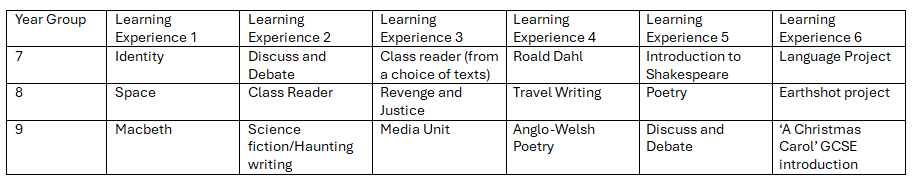
Year 7 pupils are initially taught in their form groups, before being regrouped to allow for suitable levels of challenge and support with literacy skills. We aim to provide a broad introduction to both English language and different forms of literature across Key Stage 3, which reflect the Four Purposes of the Curriculum for Wales and our What Matters Statements for Language, Literacy and Communication.
A focus on building confident reading, writing and oracy skills underpins all topics taught in years 7-9 and the texts used to support this learning become increasing challenging as pupils move through these three years. Our aim is to equip our pupils to be confident in their use of language in different contexts and for different purposes.
As we now have an integrated approach to teaching English language and literature at GCSE, we are building this approach into our Lower School teaching, particularly in year 9.
We focus on practical, hands‑on lessons that help students build important skills like teamwork, problem‑solving and resilience. Our learning is designed to be relevant and matched to students’ interests, helping every learner reach their full potential.
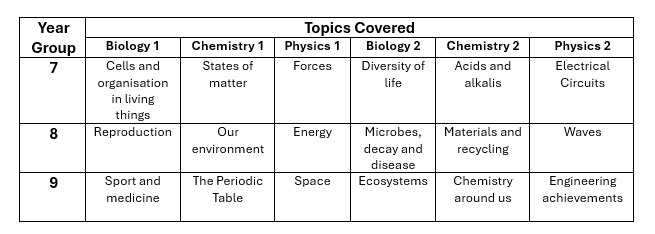
Each year of study is structured around an overarching theme that connects science to real‑world applications. Although we teach science as a combined subject, the themes include distinct topics from biology, chemistry and physics. These are outlined below, with additional support available on BBC Bitesize (KS3 Science – BBC Bitesize).
GEOGRAPHY
SCIENCE
In Year 7, students are taught in their tutor groups before being regrouped for the remainder of Key Stage 3. Our new science curriculum is built around the four purposes of the Curriculum for Wales, offering engaging and challenging topics that nurture curiosity and develop young scientific thinkers.
We focus on practical, hands‑on lessons that help students build important skills like teamwork, problem‑solving and resilience. Our learning is designed to be relevant and matched to students’ interests, helping every learner reach their full potential.
Each year of study is structured around an overarching theme that connects science to real‑world applications. Although we teach science as a combined subject, the themes include distinct topics from biology, chemistry and physics. These are outlined below, with additional support available on BBC Bitesize (KS3 Science – BBC Bitesize).
TECHNOLOGY – ENGINEERING DESIGN
Pupils complete a balanced programme of practical and theory lessons.
Year 7 In Year 7, pupils explore the question: How can we survive in extreme environments? This unit introduces students to electronic problem-solving and basic computer programming, enabling them to design and create practical solutions to challenging scenarios.
Year 8 In Year 8, the focus shifts to: How can we create a sustainable future? Pupils investigate different methods of energy generation and explore how modern technology can harness renewable resources. This includes practical work demonstrating how wind power can be converted into electricity.
Year 9 In Year 9, students consider: How have innovations in science and technology changed our world? With a strong emphasis on the iterative design process, pupils design, test, and refine multiple prototypes, culminating in the creation of a rocket-powered car.
Supporting Learning at Home
Students are encouraged to extend their learning beyond the classroom by watching online technique videos and engaging in practical making activities. Using construction kits such as LEGO or Meccano can help to further develop problem-solving abilities and practical skills.
TECHNOLOGY – HOSPITALITY & CATERING (H&C)
Pupils complete a balanced programme of practical and theory lessons.
Year 7 pupils begin by learning about the importance of nutrition and how it affects our bodies and lifestyles. Their work is guided by the focus question: Can you choose to be fit and healthy?
Year 8 builds on this nutritional understanding as pupils start to plan and prepare healthy meals. The focus question is: How do people from different countries maintain a healthy balanced diet? Pupils investigate a range of cultures and countries to support their learning.
Year 9 pupils continue to develop their knowledge of nutrition and health through the focus question: How can we create an inclusive sporting event that encourages people to be fit and healthy through physical activity and nutrition? Pupils explore the meaning of inclusivity and how it can be applied in real-life contexts.
Supporting Learning at Home
To support pupils’ progress, families can encourage cooking from scratch at home. This might include weighing ingredients, following a recipe, preparing dishes, and cleaning up afterwards. Pupils may also benefit from watching cooking programmes or online technique videos to further develop their practical skills.
TECHNOLOGY – PRODUCT DEVELOPMENT
Pupils complete a balanced programme of practical and theory lessons.
Year 7 pupils begin by learning about the importance of nutrition and how it affects our bodies and lifestyles. Their work is guided by the focus question: Can you choose to be fit and healthy?
Year 8 builds on this nutritional understanding as pupils start to plan and prepare healthy meals. The focus question is: How do people from different countries maintain a healthy balanced diet? Pupils investigate a range of cultures and countries to support their learning.
Year 9 pupils continue to develop their knowledge of nutrition and health through the focus question: How can we create an inclusive sporting event that encourages people to be fit and healthy through physical activity and nutrition? Pupils explore the meaning of inclusivity and how it can be applied in real-life contexts.
Supporting Learning at Home
To support pupils’ progress, families can encourage cooking from scratch at home. This might include weighing ingredients, following a recipe, preparing dishes, and cleaning up afterwards. Pupils may also benefit from watching cooking programmes or online technique videos to further develop their practical skills.